Follow this very simple framework.
The findings will give you hugely valuable insights for your business’ marketing. Remember, to be inspired – not to copy.
You’ll need 2-3 hours, about the time it takes to watch a long movie.
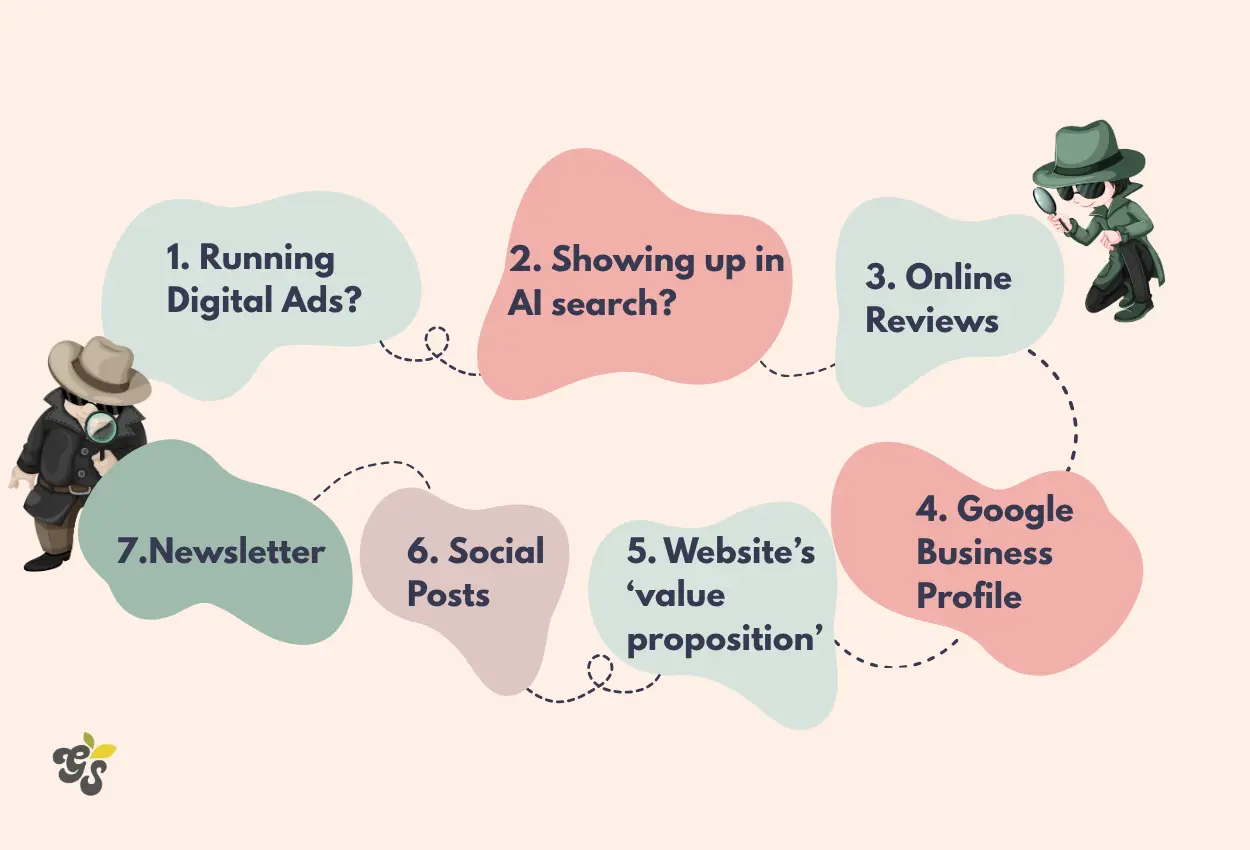
First, think of 2-3 competitors
They need to be a similar size to you and to be after the same customers you are targeting.
Next, pop these headers into a table
▪️Ads ▪️AI▪️Reviews▪️Google Business Profile▪️Value Proposition▪️Social Posts▪️Emails
Now complete this process…
1. Find out, is your Competitor is running Digital Ads?
This is easy! Take a nosey in the Meta Ads Library for Facebook or Instagram ads
or the Google Ads Library
or the Linkedin Ads Library
Look at the ads – what is the primary product or service they’re promoting?
Drill into the key benefits they offer. If they’re spending money on ads, they will have worked on their messaging. How can you sharpen yours?
Check their ad variations – what messaging are they testing?
Look at their visuals or video – does it give you ideas for new content?
2. Use a Free Tool to see how the Competition is showing in AI Search
There’s some great free software which will scan websites URLs, and rate how they’re showing in AI.
Try a free trial on Am I on AI, Gushwork.ai or Usehall.
These tools are known as ‘AI search graders’.
They’ll use real user responses from conversational AI platforms like ChatGPT, Google AI Overviews, Perplexity and Microsoft Copilot.
Discover if your competitors rank Good or Bad, and what the search results are saying about their visibility tips. Do you have any insights you can apply to help your findability?
3. Look for their Online Reviews
Type your competitor’s name into Google. Or look at Feefo or Trustpilot. Or look on Facebook. Do they have reviews?
Look at what their fans are saying.
What problems are their customers saying they’ve solved for them?
If you have the same target market, this is likely to be what your audience is wanting from you too!
Would it benefit your business to seek testimonials on these platforms too?
Trust is, of course, a major driver for turning prospects into leads.
4. Check their Google Business Profile
To find this, open Google Maps and search for your competitor’s business name.
You’ll find their business listing in the search results.
Take a careful look at the wording, plus the images they’ve uploaded to their Business Profile to attract new customers.
Can you optimise your Business Profile in a similar way?
This little nugget increases online visibility, helps you get found in organic search and can attract local customers.
5. Read the ‘Value Proposition’ on their Site
What’s a value proposition? Well, it’s simply a short summary of what your competitor from the p.o.v. of the needs and wants of their customers.
Go to your competitor’s website and read the 2-3 lines on the home page that are visible before you scroll down.
Ask yourself; how are they trying to set themselves apart? Who are they aiming to speak to?
Check your own site. Have you nailed a value proposition? Can you tighten up your own to give you an edge?
6. Study their Social Posts
What social channels are they on? Are your potential customers to be found here too?
Screen shot 4-5 posts that jump out.
Take a moment to consider the images and wording.
What are the key benefits they’re offering around their product or service? How will it help people? Are these benefits the same as yours – and are yours as clear?
How are they using their tone of voice to talk to potential customers? Is yours as user-friendly?
7. See if they have a Newsletter.
Ok, you may have to wait a bit to receive your competitor’s newsletter or email, When you do, study the layout.
Is it easy to read? Do key messages jump off the email?
What are their calls to action – how are they nudging the reader to call/sign up/buy? Are your calls to action as clear as they could be?
Do they offer discounts? What sort of % are they offering to their warm audiences?
Could you do this too?
💡 Use these insights to make small but powerful tweaks to your own marketing.
💡 The aim here is not to copy but to spark inspiration for upping your game.
💡 By comparing and contrasting what your competitors are doing, you’ll be able to sharpen your own marketing.
One final note – and appreciate I’ve talked about the competition as ‘other’ in this post (!) If you can, try not to see other businesses in your field as ‘competition’.
There are so many benefits to be gained from working together. From sharing logistics, pooling resources, looking at partnerships for campaigns or even working out complimentary offers, try to see how you can work together. There’s strength in collaboration.
——————————————————————–
If you’d like someone to do marketing analysis for you, I regularly audit performance for SMEs and 3rd sector organisations.
You can work with me to help you roll out a new offer, to fix your customer journey or to deliver content strategy.
Set up a short call to find out how I can help your business.
Copyright © Paula Gilbert 2025. All rights reserved.